Last checked October 2026 against the DFA’s list of valid IDs for passport applications, the PhilSys FAQ, Bangko Sentral ng Pilipinas issuances on customer identification, the NBI’s application guide, and LTO, PRC and PHLPost fee references. Each office sets its own list, so confirm with the office before you go.
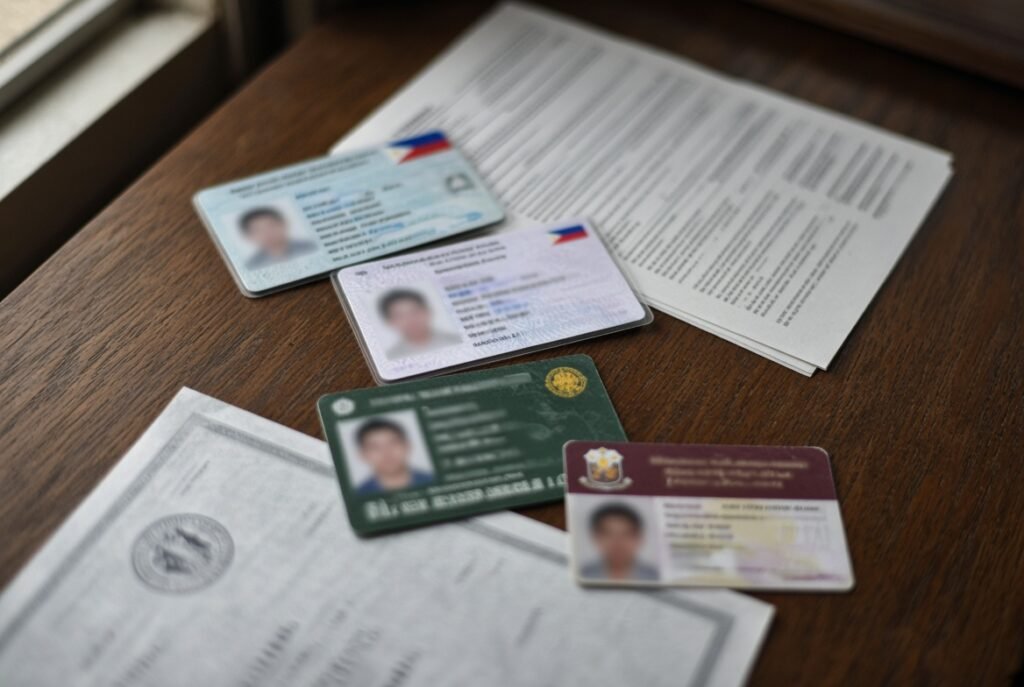
No single government list of “valid IDs” applies everywhere in the Philippines. The DFA, banks, the NBI, employers and airlines each decide which cards they accept, and their lists overlap only partly. That is why an ID that works at a bank may still get you turned away at the passport window. This guide starts from what you are trying to do: open an account, get a passport, apply for a job or deal with a government office. It shows which IDs to bring for each, which cards carry the most weight, how to replace the common ones if they are lost, and which documents usually get rejected.
Which ID should you bring? A quick routing table
| What you are doing | Strongest ID to bring | Good backup | Watch out for |
|---|---|---|---|
| Passport application or renewal (DFA) | PhilSys National ID, ePhilID or a printed Digital National ID | One ID from the DFA’s “in lieu” list, such as UMID or SSS ID, LTO license, PRC ID, Postal ID or voter’s ID | Bring the original and a photocopy. School IDs need extra papers. |
| Opening a bank or e-wallet account | PhilSys National ID | Passport, driver’s license, UMID or MySSS Card, Postal ID | Banks may apply their own risk checks and ask for proof of address or income. |
| NBI clearance | Two original, unexpired government IDs | National ID plus passport, license, UMID or Postal ID | The ID you pick online should be one you will actually bring. |
| PSA civil registry documents at an outlet | Any valid government photo ID of the requester | A second ID if you are requesting for someone else | Authorization papers are also needed for third-party requests. |
| New job (pre-employment) | National ID or passport | Driver’s license, Postal ID, UMID | HR also asks for your TIN, SSS, PhilHealth and Pag-IBIG numbers, which are not IDs in themselves. |
| Domestic flight or provincial bus | National ID, passport or driver’s license | Any government photo ID; student ID for students | Each airline or bus line sets its own list; the name must match the booking. |
| Senior or PWD discount | OSCA senior citizen ID or PWD ID | For seniors, any government ID with a birthdate is often accepted | Discount rules require the specific ID; check the establishment. |
| Receiving a remittance or claiming a padala | National ID | Passport, driver’s license, Postal ID | Name spelling must match what the sender typed. |
Why the PhilSys National ID comes first
Republic Act No. 11055, the Philippine Identification System Act, makes the PhilID valid proof of identity for government and private transactions, subject to authentication. The Bangko Sentral ng Pilipinas told banks in Memorandum M-2022-003 to accept the PhilID as official and sufficient proof of identity, without asking for another ID. The PhilSys FAQ says refusing the card without a valid reason can lead to a fine of ₱500,000, and it asks the public to report refusals to info@philsys.gov.ph. Include the date, the name of the establishment and branch, its address, the transaction and the reason given.
The paper ePhilID and the Digital National ID in the eGovPH app are also accepted for many transactions. The DFA, for instance, lists the PhilID, the ePhilID and a printed Digital National ID first on its list of valid IDs for passports. If you have not registered yet, our PhilSys National ID guide and our guide to the Digital National ID walk you through it. For the app, see our eGovPH app guide.
Primary vs secondary IDs: how the main offices treat each card
“Primary” and “secondary” are not fixed legal categories. Each office decides which IDs are enough on their own and which need support. The matrix below shows how common cards are treated by the offices most people deal with.
| ID | DFA passport | Banks (BSP list) | NBI clearance | Notes |
|---|---|---|---|---|
| PhilSys National ID, ePhilID, Digital National ID | Primary (listed first) | Sufficient on its own (M-2022-003) | Accepted | Free for citizens at first issuance |
| Passport | Accepted for renewal | Accepted | Accepted | The strongest backup for travel and banks |
| UMID, SSS ID or MySSS Card | Accepted in lieu | Accepted (SSS ID) | Accepted | Old UMIDs remain valid |
| GSIS eCard | Accepted in lieu | Accepted | Commonly accepted | For government workers |
| LTO driver’s license | Accepted in lieu (card-format student permits included) | Accepted | Accepted | Must be unexpired |
| PRC ID | Accepted in lieu | Accepted | Commonly accepted | For licensed professionals |
| Postal ID | Accepted in lieu (newer cards) | Accepted | Accepted | Card is mailed, which also proves your address |
| Voter’s ID or voter’s certificate | Accepted in lieu (certificate from COMELEC main office) | Accepted | Commonly accepted | COMELEC no longer issues new voter’s ID cards |
| Senior citizen ID | Accepted in lieu | Accepted | Commonly accepted | Issued by the city or municipal OSCA |
| OWWA e-Card or OFW ID | Accepted in lieu (OWWA e-Card) | Accepted | Commonly accepted | For OFWs |
| Seaman’s book (SRB/SID) | Accepted in lieu (MARINA, newer issues) | Accepted | Commonly accepted | For seafarers |
| School ID | Only with extra papers (see below) | Limited cases only | Usually not enough | Treat as secondary |
| Barangay ID or certificate | Not on the DFA list | Barangay certification is on the older BSP list | Usually not enough | Good as proof of address |
| Company ID | Not on the DFA list | Only IDs from BSP-, SEC- or IC-regulated employers | Usually not enough | Treat as secondary |
The DFA’s extra rules for school IDs
Minors can use a certificate of enrolment with a photo and the school’s dry seal. Adults who are still students need their school ID plus a certificate of registration. If you are a student applying for a first passport, getting the free National ID first is often simpler.
What banks actually need
BSP Circular 608 (2008) gives the long list of IDs that banks may accept, including the passport, driver’s license, PRC ID, NBI and police clearances, Postal ID, voter’s ID, GSIS and SSS IDs, the senior citizen ID, OWWA and OFW IDs, the seaman’s book, the ACR or ICR for foreigners, other government and GOCC IDs, and company IDs from regulated employers. Students not yet of voting age who receive remittances may use a school ID. BSP Circular 1022 (2018) added PhilSys. In practice, each bank also runs its own risk checks. You may be asked for a selfie, proof of address or a source-of-funds explanation, especially for higher-tier accounts. Our guide to opening a basic deposit account covers the low-requirement option.
What usually gets rejected
| Document | Why it gets turned down | What to bring instead |
|---|---|---|
| Expired ID | Most offices, including the NBI, ask for unexpired cards | Renew first, or bring another valid ID |
| Photocopy or phone photo only | Offices inspect the original | Original, plus photocopies if the office asks |
| Damaged, faded or tampered card | The DFA requires IDs that are readable, untampered and consistent | Replace the card; see the next section |
| ID with a different name or birthdate from your PSA record | Details must match across documents | Fix the record first; bring your PSA marriage certificate if you use a married surname |
| Company or school ID alone, for a passport | Not enough on the DFA list | National ID or one ID from the DFA’s in-lieu list |
| Barangay clearance as your only ID | Usually treated as proof of residence, not identity | Get a National ID or Postal ID using your birth certificate |
| Club, association or membership cards | Not government-issued | A government photo ID |
| “Temporary” paper receipts of an ID application | Not an ID card | Wait for the card, or use the ePhilID or Digital National ID |
How to replace common IDs if they are lost or damaged
| ID | Where to go | What to bring | Published fee |
|---|---|---|---|
| PhilSys National ID (peeled-off photo or damaged) | PSA regional or provincial office | Fill out the form and surrender the card; PSA sends an SMS when the replacement is ready | Free for peeled-off photos, per the PhilSys FAQ |
| PhilSys National ID (lost or stolen) | Wait for PSA’s announced replacement process | No re-registration needed; your PhilSys number is permanent. A notarized affidavit of loss is needed for updating services. | Per the PSA fee schedule under the revised IRR; waived with a certificate of indigency from your C/MSWDO |
| Passport (lost) | DFA consular office, by appointment | Police report and notarized affidavit of loss, both in English; a photocopy of the old passport, or your PSA birth certificate if you have none | ₱950 regular or ₱1,200 expedited, plus a ₱350 lost-passport penalty |
| LTO driver’s license (lost) | Any LTO licensing office | Application form, affidavit of loss, a valid government ID | ₱355 for a duplicate (₱455 with revision of records) |
| PRC ID (lost) | Apply through PRC’s LERIS online system, then appear at the chosen PRC office | Action sheet from LERIS and a notarized affidavit of loss | ₱250 per PRC’s 2025 Citizen’s Charter |
| UMID or SSS ID (lost or damaged) | Apply for the MySSS Card online through a partner bank | Permanent SS number, a National ID record for verification, and a facial scan | Set by the partner bank |
| Postal ID | A capturing post office | Application form, one proof of identity and one proof of address | ₱550 regular or ₱650 rush, as reported by PIA |
A few timing notes. The passport.gov.ph page mentions a 15-day clearing period when a valid passport is reported lost, so do not wait until the week of your flight. DFA processing then takes about 10 to 12 working days for regular service or 5 to 7 for expedited. The LTO’s Citizen’s Charter is older than its current fee schedule, so confirm the requirements at your office. For details on each card, see our guides to the LTO driver’s license, the MySSS Card and UMID and the Postal ID.
No ID yet? A practical order to get one
If you have only a PSA birth certificate, you can still build an ID set. Each step below uses documents you already have.
- Get your PSA birth certificate. Almost every first ID starts with it. See our PSA birth certificate guide.
- Register for the PhilSys National ID. It is free, and the ePhilID or Digital National ID can work while you wait for the card.
- Get a barangay certificate of residency. It is proof of address for the Postal ID and some bank accounts. See our barangay certificate guide.
- Apply for a Postal ID. PHLPost accepts a PSA birth certificate as proof of identity, and it mails the card to your address.
- Add an ID tied to your work or status. This could be a TIN (TIN ID guide), a MySSS Card, a PhilHealth ID (PhilHealth MDR and ID guide), a voter’s certificate (COMELEC guide), a senior citizen ID or a PWD ID.
Three illustrative scenarios
Hypothetical 1: a fresh graduate’s first job
Ana, 21, has a school ID and a PSA birth certificate. HR asks for two valid IDs and an NBI clearance. Her school ID will not be enough for the NBI. She registers for PhilSys, uses the ePhilID while waiting, and applies for a Postal ID. With those two, she books her NBI appointment. As a first-time jobseeker she can use our fee waiver guide. If HR only needs a local record check, our police clearance vs NBI clearance guide explains the difference.
Hypothetical 2: a lost wallet a month before a trip abroad
Ben lost his wallet with his driver’s license and UMID, but his passport is safe at home. He keeps using the passport as his main ID, has an affidavit of loss notarized that covers both cards, and asks each office whether a combined affidavit is fine. He then requests a duplicate license from the LTO and applies for a MySSS Card online.
Hypothetical 3: a senior opening a bank account
Lola Carmen has a senior citizen ID and a National ID. The bank asks for a second ID. Under the BSP’s memorandum, the National ID alone should be enough proof of identity. She politely mentions this, and keeps the senior ID ready as backup.
Before-you-go checklist
- Read the office’s own ID list on its website or posted requirements
- Bring two IDs even if one is asked for
- Check that each ID is unexpired and readable
- Make sure the name, birthdate and photo match your PSA record and your application form
- Bring a PSA marriage certificate if you use a married surname
- Prepare photocopies of the front and back on one page, if the office asks
- Keep the ePhilID or Digital National ID ready as a backup to the physical card
- For discounts, bring the specific senior, PWD or student ID
- If someone refuses your National ID, note the date, branch and reason for a report to PhilSys
Our government ID checklist covers more prep habits that prevent return trips, and our guides to the senior citizen ID, the PWD ID and OWWA membership cover the special-status cards.
Frequently asked questions
Is the ePhilID as valid as the plastic National ID?
For most transactions, yes. The DFA lists the ePhilID and a printed Digital National ID alongside the PhilID card. Some private offices still prefer the card, so bring both if you have them.
Can a bank ask for a second ID if I show my National ID?
For proof of identity, the BSP says the PhilID is sufficient on its own. A bank may still ask for other documents for other reasons, such as proof of address or income.
Is a barangay ID a valid government ID?
It is issued by a local government, but many offices treat it as proof of residence rather than identity. It is not on the DFA’s passport list.
Are old UMID cards still valid?
Yes. SSS says previously issued SSS cards remain valid. Replacements now come as the MySSS Card.
What is the cheapest ID to get?
The PhilSys National ID, which is free for citizens at first issuance.
Sources
All sources checked October 25, 2026.
- DFA: Valid IDs for passport application: PhilID and in-lieu IDs, school ID rules, original and photocopy, readable and untampered IDs
- DFA Office of Consular Affairs and passport.gov.ph: passport fees, lost passport requirements and penalty, clearing period, processing times
- PhilSys FAQ (last updated February 13, 2026): refusal reports, ₱500,000 fine, replacement of peeled-off and lost cards, permanent PhilSys number, fee waiver
- PSA Region 8: free replacement of peeled-off or damaged PhilID and updating services: affidavit of loss for updating
- Republic Act No. 11055, Lawphil: PhilID as proof of identity
- BSP Memorandum M-2022-003: PhilID as sufficient proof of identity
- BSP Circular 608 (2008): list of valid IDs for banks; school IDs for young remittance recipients
- BSP Circular 1022 (2018): PhilSys recognition in customer identification rules
- NBI: How to Apply for NBI Clearance: two original, unexpired government IDs
- LTO driver’s license fee schedule (13-CC2024-DL-FEE): duplicate license and renewal fees
- PRC Citizen’s Charter 2025, 1st edition: duplicate PRC ID fee and requirements
- SSS: MySSS Card: validity of older SSS cards and the new card
- PHLPost and the Philippine Information Agency: Postal ID requirements and fees
Questions or corrections? Email PinoyTips at admin.pinoytips@gmail.com.