A barangay certificate of residency is a signed statement from your barangay that you live at a stated address within its boundaries. It usually also states how many months or years you have lived there. It is one of the most requested papers in the Philippines. So many applications need proof of address, from the Postal ID to school enrollment to a new bank account. The certificate is simple to get. Yet people still waste trips because they ask for the wrong paper or forget to state the purpose.
Residency, clearance, indigency: three different papers
Barangay halls issue several documents that sound alike, and each one answers a different question.
- Barangay certificate of residency – confirms that you live in the barangay and, often, since when.
- Barangay clearance – states that you have no derogatory record in the barangay. Employers and some permit offices ask for this. Under the Local Government Code (RA 7160), a barangay clearance is also a prerequisite for business permits.
- Certificate of indigency – states that you are considered low-income by the barangay. Assistance programs and public hospitals may ask for it.
Many barangays print several of these from the same system, so say clearly which one you need. If the receiving office wrote the exact title on its checklist, show that checklist to the barangay staff.
Where a certificate of residency is commonly required
Proof of address comes up in a long list of errands. A few common ones:
- Postal ID. PHLPost Circular No. 25-48 lists a barangay certificate of residency among accepted proofs of address for new Postal ID applicants. Our Postal ID guide covers the full list.
- Bank and e-wallet accounts when your ID shows an old address.
- School enrollment in public schools that prioritize local residents.
- LGU services such as a Senior Citizen ID, PWD ID, or local scholarship, which are issued by the city or municipality where you live.
- Voter registration or transfer, where COMELEC checks residency in the locality.
Because the requirement comes from the receiving office, ask that office how recent the certificate must be. Some want one issued within the last three months.
What to bring for a barangay certificate of residency
Requirements are set by each barangay, so they vary. In practice, most halls ask for some combination of the following:
- a valid ID, ideally one that shows your current address;
- proof that you live there if your ID shows another address, for example a utility bill, lease contract, or a letter from the property owner;
- a community tax certificate (cedula) for the current year, which many barangays still require for certifications;
- the purpose, written down, for example “Postal ID application” or “school enrollment”.
Some barangays ask new residents to wait until they have lived there for a minimum period. Others ask a neighbor or the purok leader to vouch for them. If you just moved, ask the barangay secretary what they accept rather than assuming you can get the certificate on day one.
How a barangay certificate of residency request usually goes
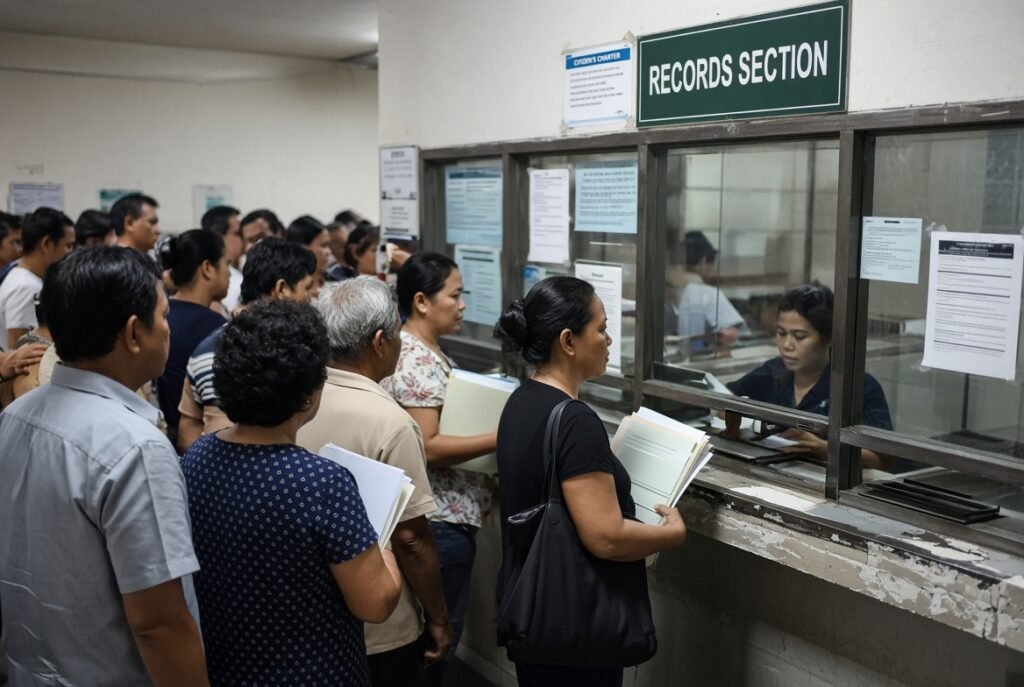
- Go to the barangay hall during office hours. Some barangays now accept requests through a Facebook page or an online form and ask you to pick up the printed certificate later.
- Fill out the request slip with your full name, address, length of residency, and purpose.
- Pay the fee at the barangay treasurer and keep the official receipt.
- Wait for the certificate to be printed and signed by the Punong Barangay or an authorized official, with the barangay dry seal.
Check the printout before you leave. The name must match your ID exactly, including the middle name, and the purpose line must match what the receiving office expects. A wrong purpose is a common reason for a second trip.
Fees and validity of the certificate
Each barangay sets fees for a barangay certificate of residency through its revenue ordinance. That is why amounts differ from one hall to the next. We do not quote a national rate because there is none. Ask for the official receipt, and if the amount looks unusual, ask to see the posted schedule of fees.
Validity is also not fixed nationally. Many receiving offices treat a certificate as current for about three to six months. Some barangays, however, print their own validity period on the paper. Therefore, follow whichever is stricter: the date on the certificate or the rule of the office receiving it.
Free certificates for first-time jobseekers
Republic Act No. 11261 says government offices, including LGUs and barangays, cannot charge first-time jobseekers for documents usually required for employment, and it specifically lists the barangay clearance. To use the benefit, you first get a barangay certification that you are a first-time jobseeker, together with an oath of undertaking.
That certification is what other agencies, like NBI and the PNP, look for when you claim a free clearance. Our guide to the first-time jobseeker fee waiver explains how the papers fit together and what the law excludes.
What a barangay ID is, and what it is not
Some barangays issue their own resident ID card. It is useful inside the barangay, for example for local aid distribution or access to barangay facilities. However, it is an LGU card, not a national government ID, so offices outside the barangay may treat it only as supporting proof or refuse it outright.
So if your goal is a dependable primary ID, the barangay ID is not the answer. The National ID is free and accepted widely; see our PhilSys registration guide. For a broader comparison, read valid government IDs in the Philippines.
Barangay certificate of residency for minors and students
Students may need a barangay certificate of residency for public school enrollment, local scholarships, or SK programs. Since minors usually have no ID with an address, the barangay commonly asks a parent or guardian to come along with their own ID and to sign the request.
Bring the student’s PSA birth certificate or school ID as well, so the barangay can match the child to the household. If the family recently moved, ask the school whether a certificate stating a short residency period is enough, because some scholarship rules require a minimum number of years in the municipality.
Sending a representative for your barangay certificate of residency
Barangays often allow a representative to request or claim a certificate, but only with written authorization. Prepare a short signed letter naming the representative, a photocopy of your ID, and the representative’s own ID. Without the letter, staff are right to refuse, since the paper certifies facts about you.
For OFWs and people working in another city, ask whether the barangay can prepare the barangay certificate of residency in advance after a phone or Facebook request, so the representative only needs to pick it up.
Renters, boarders, and people who just moved
Renters face the most questions at the barangay hall, since their names do not appear on a land title or electric bill. Fortunately, there are several ways to show you live where you say you live. A signed lease contract works in many barangays, and so does a short certification from the landlord with the landlord’s ID attached. Some halls also accept a utility bill in the landlord’s name together with that certification.
Meanwhile, students in boarding houses near universities are a routine case for barangays in school districts, and staff are usually familiar with the paperwork. Bring your school ID and the boarding house owner’s contact details.
If you moved recently, you may also need to update other records so your address matches across documents. For instance, a voter who moved should transfer registration with COMELEC during the registration period, and the COMELEC website announces when that window reopens.
Problems that cause a second trip
- Wrong document type. Asking for a clearance when the office wanted residency, or the reverse.
- Name mismatch. A married surname on the certificate but a maiden name on your ID, without the PSA marriage certificate to connect them.
- Missing seal or signature. Offices like PHLPost and NBI look for the dry seal and the authorized signatory.
- Old date. A certificate issued many months ago may be rejected even if it carries no printed expiry.
- Purpose left blank. Some offices reject certificates that do not state the purpose.
If you are collecting several papers for one application, list which documents each office expects in our government document prep checklist before you go.
Quick answers
Can I get a barangay certificate of residency online? Some barangays accept online requests; many still require you to appear. Check your barangay’s official Facebook page or call the hall.
Can a boarding house address qualify? Often yes, if the owner or barangay can confirm you live there. Ask for the barangay’s rule on minimum residency.
Is a cedula always required? Not by national law for every certificate, but many barangays ask for one. It is inexpensive and issued at the barangay or the municipal treasurer.
Last checked against the PHLPost notice “PHLPost Simplifies Postal ID Application for All”, RA 11261, and the Local Government Code (RA 7160) on October 2026. Barangay fees and rules are local, so your barangay hall has the final say.