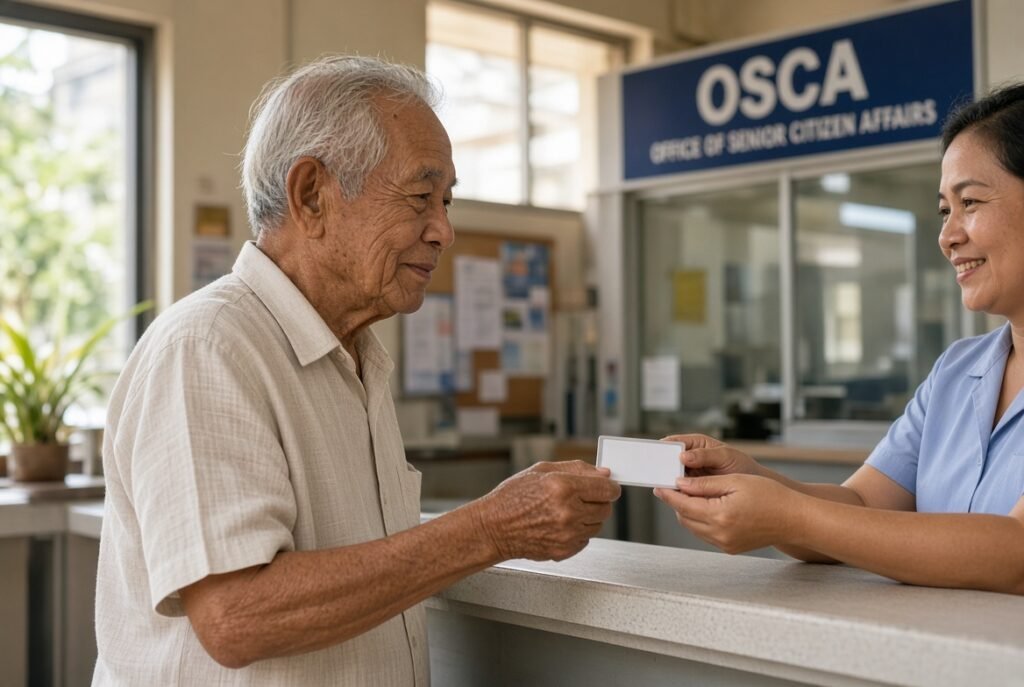
A Senior Citizen ID is the identification card issued free of charge by the Office for Senior Citizens Affairs (OSCA) of the city or municipality where a person aged 60 or older lives. Under Republic Act No. 9994, the Expanded Senior Citizens Act of 2010, establishments nationwide must honor the card from any OSCA. It is the simplest way to claim the 20 percent discount and VAT exemption that the law grants, although it is not the only document that works.
Who qualifies for a Senior Citizen ID
The law defines a senior citizen as a resident citizen of the Philippines who is at least 60 years old. Dual citizens qualify if they prove Filipino citizenship and have at least six months of residency in the Philippines, according to the law’s definition. You apply where you live, because OSCAs maintain a list of senior citizens in their city or municipality and issue cards to residents.
Many families apply a few weeks before a parent’s 60th birthday so the card is ready on the day. Ask your OSCA whether it accepts early applications, since practice varies.
Senior Citizen ID requirements
OSCAs set their own checklists, but they usually ask for proof of age, proof of citizenship, and proof of residency. A typical list includes:
- a PSA birth certificate, a passport, or a government ID that shows the birth date;
- proof of residency, such as a barangay certificate of residency, a voter’s certification, or a utility bill;
- recent ID photos, commonly 1×1 or 2×2, as the OSCA specifies;
- the OSCA application form.
If the applicant’s birth record has errors, fix those first, because the card will copy whatever the documents say. Our PSA birth certificate guide covers how to request a copy.
How to apply
- Visit the OSCA at your city or municipal hall. Some cities run satellite desks in barangays or accept applications through barangay senior citizen associations.
- Submit the form with your proofs of age, citizenship, and residency.
- Have your photo taken or submit your printed photos.
- Claim the card on the date given. Some OSCAs print it the same day; others take longer.
There is no fee. RA 9994 tasks the OSCA to issue national individual identification cards free of charge, valid anywhere in the country. So if anyone asks for a “processing fee” to rush the card, report it to the mayor’s office.
What the Senior Citizen ID unlocks
The main privilege is a 20 percent discount and exemption from VAT, if applicable, on goods and services for the senior’s exclusive use. Covered items include:
- medicines, including influenza and pneumococcal vaccines;
- medical and dental services, diagnostic and laboratory tests, and professional fees in private facilities;
- eyeglasses, hearing aids, dentures, wheelchairs, and other assistive devices;
- domestic air and sea fares, and public land transport such as buses, jeepneys, taxis, and trains;
- hotels, restaurants, recreation centers, and admission to theaters and cinemas;
- funeral and burial services for the senior.
The law also grants a minimum 5 percent discount on monthly water and electricity use, subject to conditions such as the meter carrying the senior’s name and consumption limits set in the rules.
“Exclusive use” and the restaurant rule
The implementing rules define exclusive use and enjoyment as the senior’s personal consumption. In a restaurant, the discount applies to the senior’s own meal, not the whole table. However, if every diner in the group is a senior citizen with a valid ID, each one gets the discount.
The same logic applies to medicines. The discount covers medicines for the senior, which is why pharmacies often ask for a prescription and the purchase booklet, especially for maintenance drugs.
You can claim discounts without the OSCA card
RA 9994 lists the OSCA card as one proof of eligibility. However, it also allows a Philippine passport or other valid documents establishing that the person is a citizen and at least 60 years old, such as government-issued IDs showing the birth date. The DSWD has publicly reminded establishments of this.
Even so, the Senior Citizen ID avoids arguments at the cashier, because staff recognize it instantly. Seniors who travel often should carry both the OSCA card and one other government ID. Our guide to valid government IDs explains which cards are widely accepted.
Senior Citizen ID versus the social pension
Having a Senior Citizen ID does not mean you receive a monthly pension. The social pension is a separate DSWD program for indigent seniors who meet specific conditions, such as having no regular income or pension. The OSCA often helps identify potential beneficiaries, but the ID itself is not an application.
The DSWD social pension page explains who qualifies and how payouts are made. Retired members of SSS should also check their own pension claim; see our SSS retirement pension guide.
Health coverage for seniors
Under Republic Act No. 10645, PhilHealth covers all senior citizens, and the national government pays premiums for those without other coverage. That means a senior does not need a working child to list them as a dependent. Bring the Senior Citizen ID when visiting a PhilHealth office to confirm membership status and print the Member Data Record.
Public hospitals and health centers also provide free medical and dental services to seniors under RA 9994, subject to the facility’s guidelines. Ask about the senior citizen lane, which most government hospitals operate.
Using the Senior Citizen ID on trips
For domestic flights and ferries, the 20 percent discount and VAT exemption apply to the senior’s fare. When booking online, look for the senior citizen option and be ready to present the ID at check-in, since airlines and shipping lines check it. For buses, show the ID to the conductor or at the ticket window before paying.
Ferry operators on routes covered in our Cebu to Bohol ferry guide also apply senior fares at the counter. Because each operator handles online bookings differently, check its page before buying.
Helping a parent apply for a Senior Citizen ID
Most OSCAs expect the senior to appear at least once, mainly for the photo and signature. If a parent is bedridden, ask the OSCA whether staff can visit or whether a representative may submit the papers with a medical certificate. Many LGUs accommodate this, although the process depends on staffing.
Prepare the documents the night before. For example, place the birth certificate, the residency proof, and the photos in one folder, and write the parent’s full name, birth date, and address on a card so the encoder can copy them exactly. If the parent uses a married name, include the PSA marriage certificate, because OSCA staff may ask how the name on the ID links to the birth record.
Discounts that need extra documents
Some purchases need more than the Senior Citizen ID. Pharmacies commonly ask for a doctor’s prescription and the senior’s purchase booklet for medicines, especially for multiple-month supplies. Meanwhile, the 5 percent utility discount generally requires the electric or water meter to carry the senior’s name, and the household must apply with the utility first. Ask the utility company for its form; it is not automatic.
Lost, damaged, or outdated cards
If the card is lost, return to the OSCA with a valid ID and, if they ask for one, an affidavit of loss. If the senior moves to another city, apply with the OSCA of the new residence, since OSCAs keep lists of local residents. The old card stays valid nationwide, but local benefits such as city cash gifts usually require registration in the current LGU.
Laminating the card is common and generally fine, but avoid covering any security features the LGU uses.
Local benefits that come with registration
Besides national privileges, many cities give local benefits to registered seniors, for example birthday cash gifts, free movie days, or grocery packs. Under Republic Act No. 11982, the expanded centenarians law, national cash gifts are also given at milestone ages. Because those programs rely on the OSCA list, registration with your OSCA is worthwhile even if you rarely use discounts.
Ask your OSCA what it offers, and keep your contact number current so you hear about schedules.
Seniors living abroad or splitting time
Retirees who live part of the year overseas can still hold a Senior Citizen ID, as long as they are residents of the city where they apply. Dual citizens need proof of Filipino citizenship and at least six months of residency, per the law’s definition, so bring the documents that show both.
Checklist before the OSCA visit
- Proof of age and citizenship, ideally a PSA birth certificate and one government ID.
- Proof of residency in the city or municipality.
- Photos in the size your OSCA asks for.
- An authorization letter and IDs if a relative is helping, although the senior usually needs to appear for the photo.
For general preparation tips that apply across government offices, see our government ID prep checklist.
Last checked against RA 9994 and its implementing rules on Lawphil and the DSWD notice “Govt IDs listed in IRR entitle seniors to discount privileges” on October 2026. Each OSCA sets its own checklist, so confirm with your city or municipal hall.