A TIN ID is the card or digital document that shows your Tax Identification Number, and the first thing to understand is that the number and the card are two different things. The Bureau of Internal Revenue (BIR) gives each person one TIN for life. The card only displays it. So before you apply for anything, find out whether you already have a number, because a first employer registered many people years ago without telling them.
In short: Employees use BIR Form 1902 (often filed by HR). Self-employed and mixed-income earners use Form 1901. People with no income who need a TIN for a government transaction use Form 1904. Updates, RDO transfers, and card replacement use Form 1905. The Digital TIN ID comes from ORUS and is free.
Do you already have a TIN?
Check first. The National Internal Revenue Code prohibits holding two TINs, and cleaning up a duplicate takes far longer than getting a TIN ID for the number you already own. Look for your TIN on an old payslip, a BIR Form 2316 (the certificate of withholding an employer gives you every year), a previous ITR, or an old paper TIN card.
If none of those papers survive, ask the HR or payroll office of your first job. They registered you if they withheld tax. Alternatively, the ORUS portal has a TIN verification feature, and your Revenue District Office (RDO) can look you up when you present a government ID. Do this before HR files a new Form 1902 for you, since a new employer may not check.
Which BIR form matches how you earn
The form depends on your source of income, not on the card you want.
- Form 1902 – individuals earning purely compensation income, including resident and non-resident alien employees. Employers usually file this through ORUS for new hires.
- Form 1901 – self-employed individuals, professionals, mixed-income earners, estates, and trusts. This registration also produces a Certificate of Registration (BIR Form 2303).
- Form 1904 – one-time taxpayers and people registering under Executive Order 98, meaning those who need a TIN for a government transaction even without income.
- Form 1905 – changes to an existing registration: name change after marriage, new address, RDO transfer, or replacement of a lost TIN card.
Picking the wrong form is the most common reason BIR returns an online application. For example, a freelancer who files 1902 as if they were an employee will have to redo the registration under 1901 later.
Getting a TIN ID through ORUS, step by step
ORUS (Online Registration and Update System) is the BIR’s registration portal. Use only orus.bir.gov.ph.
- Create one ORUS account using an email address you will keep.
- Choose your taxpayer type. If you already have a TIN, choose the option for registered taxpayers instead of applying again.
- Fill in the e-form that matches your income (1901, 1902, or 1904) and pick the RDO that covers your home or business address.
- Upload the required ID and supporting documents as clear scans.
- Wait for BIR to issue the TIN, then return to ORUS and request the Digital TIN ID, uploading a recent 1×1-style photo.
Afterwards, download the digital card as a file and keep a copy offline as well. When an office asks for proof of TIN, this document is what BIR now issues for the purpose.
What documents BIR asks for
Requirements differ by taxpayer type, so check the BIR’s registration requirements page for your form before you upload. In general, expect the following:
- Any government-issued ID that shows your name, address, and birth date. If it has no address, prepare a separate proof of address.
- For foreign nationals, the passport bio page and, where applicable, the ACR I-Card or work permit.
- For a surname change, the PSA marriage certificate.
- For 1901 registrants, proof of business address (lease or title) and, where relevant, a DTI business name certificate or mayor’s permit.
Use the exact name printed on your PSA birth certificate. A middle name typed differently on ORUS than on your ID is a frequent reason for a returned application.
Is the Digital TIN ID a valid ID?
The Digital TIN ID proves that a TIN belongs to you. BIR introduced it through Revenue Memorandum Circular No. 120-2023, and it replaced the old practice of queuing at an RDO for a paper card. However, whether a bank or employer accepts it as a stand-alone identity document is that institution’s decision. Many treat it as proof of TIN and still ask for a primary photo ID, such as a passport, driver’s license, or the National ID.
If a desk insists on a laminated card, ask your RDO whether it still prints them for your case. Keep the digital version handy; it carries the same number.
For a wider look at which cards count as primary, read our guide on valid government IDs in the Philippines.
Questions first-time job seekers ask
Republic Act No. 11261, the First Time Jobseekers Assistance Act, lists the TIN among the documents government agencies cannot charge a first-time jobseeker for. In practice, BIR does not charge a fee for a Form 1902 or 1904 registration anyway, so the waiver matters more for the other papers on your pre-employment list. Our guide to the first-time jobseeker fee waiver covers the barangay certificate that unlocks it.
If your new employer files your 1902, you do not need to visit an RDO at all. Ask HR for the TIN once BIR issues it, then generate the TIN ID yourself in ORUS.
When you still need to visit an RDO
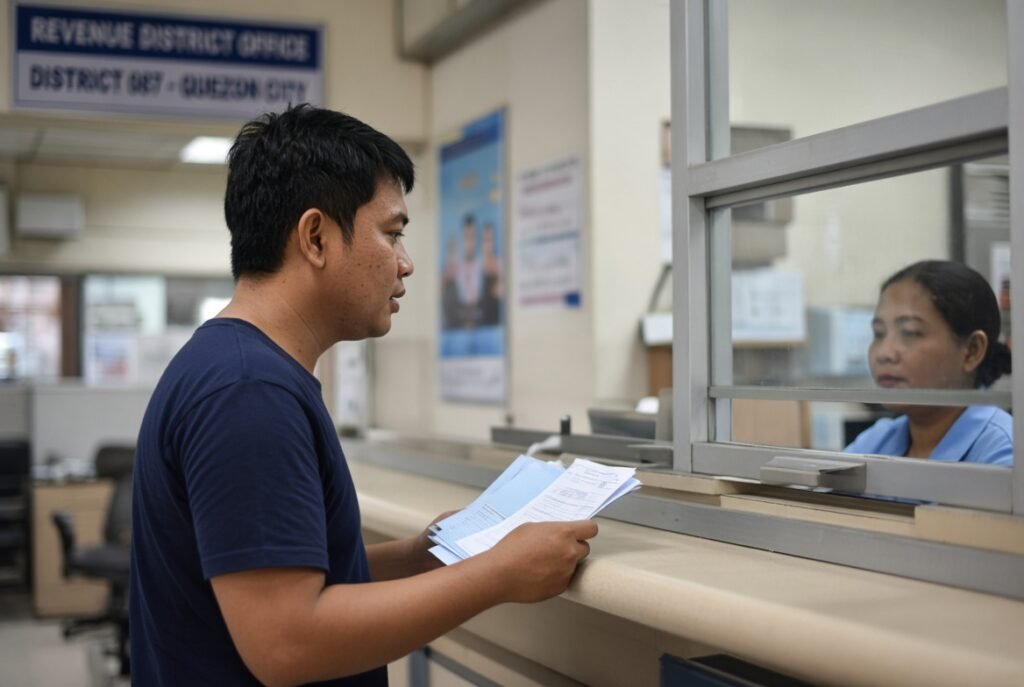
ORUS handles most new registrations, but some cases still end at a Revenue District Office. These include correcting a birth date or name that someone encoded wrongly years ago, merging or cancelling a duplicate TIN, and registrations where the portal rejects your documents repeatedly. Estates of deceased taxpayers and some foreign nationals are often asked to complete the process in person.
Before you go, look up the RDO that covers your address on the BIR website, because the wrong district office will usually send you elsewhere. Bring the original ID and a photocopy, the printed form, and any document that proves the correction you are asking for, such as a PSA birth certificate. Arrive early in the day; RDOs commonly cap the number of walk-in clients they serve. Ask the officer for a stamped receiving copy so you can follow up without starting over.
Self-employed: more than a TIN ID
For freelancers and small business owners, a TIN ID is only the start. Registering under Form 1901 also means a Certificate of Registration, registered books of accounts, and invoices. Since the Ease of Paying Taxes Act (RA 11976) took effect in 2024, the old ₱500 annual registration fee no longer applies, and the term “invoice” replaced “official receipt” for most sales documents.
You will also file returns. If you are mixed-income, meaning you have a salary and a side business, read the BIR annual income tax return page before April, because substituted filing through your employer no longer covers you.
Lost TIN ID, moved house, or changed name
A lost card never means a new TIN. Instead, file Form 1905 for a replacement, or simply download the Digital TIN ID again from ORUS.
When you move to a different city, your registration should move to the RDO covering the new address. That transfer also goes through Form 1905. A woman who takes her husband’s surname updates her BIR record through 1905 with the PSA marriage certificate, so that the name on her TIN ID matches her other IDs.
Keep the reference number ORUS gives you for each request. If the update does not reflect after the processing period, the RDO will need that number to trace it.
Avoiding fake TIN ID offers
Facebook pages and “agents” sell laminated TIN cards for a few hundred pesos. BIR does not issue those cards, and they may print a number that belongs to someone else or does not exist. Worse, you hand over a copy of your ID to a stranger. Because ORUS issues the real TIN ID at no cost, there is no reason to pay anyone.
Therefore, type the BIR address yourself rather than clicking ads, and treat any site asking for a “processing fee” for the TIN ID as a scam. If you are preparing several government documents at once, our government ID and document prep checklist covers photocopies, photos, and appointment planning in one place.
Quick TIN ID FAQ
Can I have two TINs? No. One person, one TIN. If you discover you have two, go to your RDO and ask it to cancel the duplicate.
Do students need a TIN? Only when a transaction requires it, for example a scholarship stipend or a first job. Students without income who need one for a government transaction use Form 1904.
How long does ORUS take? It varies by RDO workload. Check your ORUS account and email rather than reapplying.
Can a representative apply for me? For RDO visits, bring a signed authorization and both IDs. For ORUS, the account should be yours.
Last checked against the BIR Registration Requirements page, the ORUS portal, and RA 11261 on Lawphil on October 2026. BIR rules change through new circulars, so if anything here differs from the BIR site, follow the BIR. See our editorial policy for how we check and correct guides.