DSWD AICS guide, updated October 21, 2026.
The moment everything gets expensive
It usually happens fast. A family member is rushed to the hospital. A loved one passes away. A fire takes your home. Then suddenly you need tens of thousands of pesos you don’t have, and you’re being asked for papers you’ve never heard of.
Here’s the good news: the government has a program for exactly this. It’s called AICS, short for Assistance to Individuals in Crisis Situations, run by the Department of Social Welfare and Development (DSWD). It’s free, too, and you don’t need a connection to get it.
The not-so-good news: it’s easy to get turned away for a missing paper. This guide is here so that doesn’t happen to you.
The short version
- DSWD AICS is a one-time stop-gap, not a monthly allowance.
- A DSWD social worker decides who gets help and how much.
- Bring a valid ID plus the papers for your specific problem, and start the paperwork early.
- Never pay anyone to apply.
So what exactly is DSWD AICS?
Think of it as a bridge. It doesn’t solve your money problems forever. Instead, it helps you get across one bad stretch, like a hospital stay, a burial, or a trip home, without sinking into debt.
Depending on your situation, DSWD can give you:
- Money for medical, funeral, food, transport, or emergency needs
- Goods and supplies (non-food items)
- Someone to talk to, since counseling is part of the program
- Referrals to other offices for legal help, shelter, or services DSWD doesn’t offer
Some offices also give school-related help to qualified students, with working students in public schools usually first in line.
What DSWD AICS is not: it isn’t 4Ps, it isn’t paid every month, and nobody can promise you an approval. Not a Facebook page, not a “fixer”, and not a friend of a friend.
Start here: what’s your problem?
Different problems need different papers, so find yours below, then jump to the checklist later in this guide.
| Your problem | The help to ask for | The key paper |
|---|---|---|
| Hospital bill you can’t pay | Medical assistance (hospital bill) | Statement of account + medical certificate |
| Need medicines or a medical device | Medical assistance (medicine/device) | Doctor’s prescription or price quotation |
| Lab tests or special treatment | Medical assistance (lab/therapy) | Lab request + official price quotation |
| Someone died and you can’t cover the funeral | Funeral assistance | Death certificate + funeral contract or bill |
| Stranded away from home | Transportation assistance | Police blotter, medical certificate, or other proof |
| Fire, flood, or other disaster | Cash relief or food help | Barangay or BFP certification, calamity proof |
| Nothing to eat right now | Food assistance | Certification from your local social welfare office |
“Will I even qualify for DSWD AICS?”
This is the question everyone asks, and the honest answer is: it depends on the social worker’s assessment. There is also no published income cut-off. DSWD AICS is meant for people with low incomes, in vulnerable situations, or in a real crisis.
During your interview, the social worker will basically be asking three things:
- How serious is the problem? A big, urgent need counts for more.
- Do your papers back it up? Documents are your proof.
- What can you already tap? For example, PhilHealth, your LGU, family, or other agencies.
That’s why two people with the same hospital bill can still get different amounts. It’s not personal. Instead, it’s a case-by-case decision.
Tip: Be honest and clear. A calm two-minute explanation (what happened, what you need, what you’ve already tried) helps more than a pile of random papers.
Cash or guarantee letter? What you’ll actually receive from DSWD AICS
Approved help usually comes in one of two forms:
- Cash, handed to you after approval.
- A guarantee letter (GL), which is DSWD’s written promise to pay the hospital, pharmacy, or funeral parlor directly, up to a set amount.
For big bills, though, expect a GL. You hand it to the billing section, they deduct the amount, and then you only pay what’s left. Before you leave the DSWD desk, ask which one you’re getting and where to bring it.
Your DSWD AICS paper checklist, by problem
For every request, bring a valid government ID of the person being interviewed. It needs a photo and signature, and your name must also be spelled right. After that, bring what fits your problem.
If it’s a medical problem
Bring one paper proving the condition:
- Medical certificate or clinical abstract
- Discharge summary
- Certificate of confinement
- Alagang Tagubilin form
- Referral letter from a Malasakit Center
Then add the paper for what you need paid:
| You need help with | Also bring |
|---|---|
| A hospital bill | Hospital bill or statement of account. Already discharged with a balance? Add a certificate of balance or promissory note. |
| Medicines, implants, or devices | Prescription, treatment plan, or price quotation |
| Lab procedures | Lab request and an official price quotation |
| Therapy or special treatment | Treatment plan, PhilHealth certification, or a psychiatrist’s or psychologist’s certificate |
Watch out: Medical papers should show the doctor’s full name, signature, and license number, and should be no older than three months. Missing any of these is one of the most common reasons people get sent home.
If it’s a funeral
- Your valid ID
- Proof of death: a death certificate, or a certification from the hospital or doctor (for Moro families, an Imam; for Indigenous Peoples, an Indigenous community leader)
- Proof of expense: a funeral contract or statement of account. This isn’t needed for Moro and IP families following customary burial. If your family built the coffin and still owes for materials, a barangay certification works.
- A transfer and quarantine permit, if the remains are going to a province
- A promissory note or certificate of balance, if the funeral parlor is still owed money
If you need to get home
Bring your ID plus one paper that fits your story:
- Police blotter or certification, if you were scammed, robbed, or illegally recruited
- Death certificate, if you’re going home for a wake or burial
- Medical certificate saying you’re fit to travel, if you have a health condition
- Court order, subpoena, or referral from another agency, barangay, or social welfare office
Transport help is usually given once, mainly to go back to your home province. It can also cover going to a relative’s funeral, caring for a sick relative, or rescuing a family member affected by trafficking, illegal recruitment, or disaster.
If you need food or emergency cash
- Food help: valid ID plus a certification from your local social welfare office showing you’re in crisis, need food, or live in an area under a food emergency.
- Cash relief: valid ID plus proof of your situation, such as a police report, barangay blotter, or BFP certificate (fire), proof of repatriation (overseas Filipinos), a calamity declaration, a medico-legal certificate, or a Disaster Assistance Family Access Card.
People affected by fires and disasters often apply through their barangay or LGU, which then coordinates with DSWD.
The paper that trips everyone up: the case study
For bigger requests, DSWD wants a Social Case Study Report. According to the program FAQs, that’s ₱10,000 and up, though some offices ask for it more often, especially for hospital bills and medicines.
It’s basically a social worker’s write-up of your situation. Your city or municipal social welfare office, your hospital’s medical social worker, or a registered social worker can prepare it.
The fix: Ask for it on day one. If a family member is in the hospital, go to the hospital’s medical social worker first, before you even head to DSWD. This report takes time, so it’s the step that holds up most big requests. Submit originals or certified true copies, too.
Can I ask again? How often you can apply for DSWD AICS
DSWD sets limits so help can stretch to more families:
| Type of help | How often |
|---|---|
| Medicines, lab tests, special treatments | Once every three months |
| Hospital bill | Once per hospital stay |
| Funeral | Once per person who died |
| Transportation | Usually once, or depends on the situation |
| Cash relief and goods | Once, based on the immediate need |
So if you need medicine every month, plan around the three-month window and keep your prescriptions fresh.
What happens on the day you apply for DSWD AICS
Where to go: your nearest DSWD field office or satellite office, the DSWD desk at a hospital with a Malasakit Center, or your city or municipal social welfare office (they can assess you and endorse you to DSWD). In Metro Manila, the Central Office’s Crisis Intervention Unit is in Batasan, Quezon City.
- Get in line. Show your ID and papers so you can get a queue number.
- Have your interview. A social worker then checks your documents, asks about your situation, and recommends the type and amount of help.
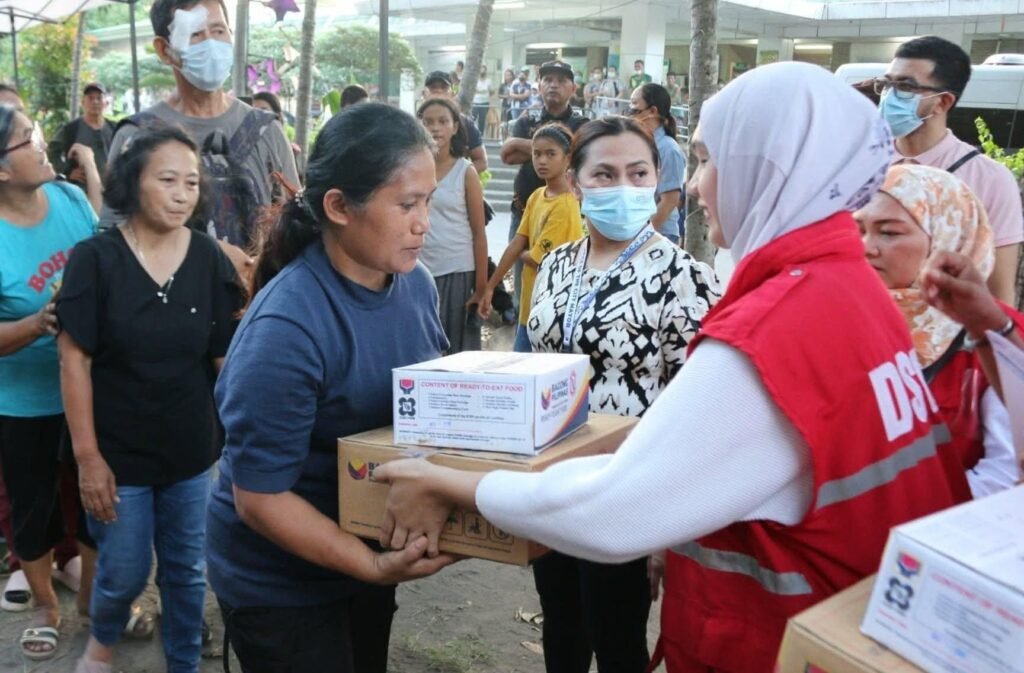
- Receive your help. You’ll then get cash, a guarantee letter, or goods.
Some offices also ask for a barangay certificate of indigency or residency, so ask ahead.
Illustrative example: applying for hospital assistance
This is a hypothetical walkthrough based on published DSWD AICS rules, not a documented real case.
Suppose a tricycle driver’s daughter is admitted with dengue. After PhilHealth, the family still owes ₱18,000. Here’s how the request could go smoothly:
- He would go to the hospital’s medical social worker first. Since the amount is over ₱10,000, the social worker prepares the case study, and billing signs a statement of account.
- He would then bring his ID, the clinical abstract, the statement of account, and the case study to the DSWD desk at the hospital’s Malasakit Center.
- After the interview, the social worker may recommend a guarantee letter. He gives it to billing and the amount is deducted.
- If his daughter needs follow-up medicines, he can apply again three months later with a new prescription.
What makes this work? He starts with the person who prepares the hardest paper, and he comes with everything in one folder.
Why requests get stuck (and how to fix each one)
| What goes wrong | How to avoid it |
|---|---|
| Doctor’s papers are old or incomplete | Ask for fresh ones with full name, signature, and license number, issued within three months. |
| Hospital bill isn’t signed or itemized | Ask billing for a signed statement of account before you go. |
| No case study for a big amount | Ask the medical social worker or local social welfare office right away. |
| ID is expired or has no signature | Check it before you go and bring a second ID. |
| Someone applies for the patient without their own ID | The family member needs a valid ID and must explain their relationship to the patient. |
| You arrive too late | Go early, since many offices serve only a limited number of people a day. |
Tips for a smoother visit
- Bring originals and photocopies, in the order they’ll be asked for.
- Call the office first, because requirements can differ slightly from place to place.
- Keep your story short and honest: what happened, what you need, what you’ve tried.
- Before leaving, ask: Where do I claim this? When can I ask again?
What if you’re turned down, or it’s not enough?
DSWD AICS is one layer of help, not the only one. Try these too:
- PhilHealth: make sure you’ve claimed every benefit you’re entitled to.
- Your LGU: many cities, towns, and mayors’ offices have their own medical, burial, or emergency aid.
- PCSO: the Philippine Charity Sweepstakes Office also has a medical assistance program. Check its current requirements before you go.
- Malasakit Centers: several agencies under one roof in participating hospitals.
- OWWA: if you or your family are overseas Filipino workers, you may also have separate help.
- Ask what was missing. Politely ask the social worker why, because often it’s one paper you can fix.
Don’t get scammed
When people are desperate, scammers show up. Protect yourself:
- DSWD AICS is free. Never pay for a queue number, forms, or “fast approval.”
- Ignore pages offering “online AICS applications” for a fee, or asking for your e-wallet PIN or OTP.
- Instead, stick to official DSWD offices, the AICS website, and DSWD’s verified social media pages.
- Report suspicious offers through DSWD’s official hotlines or email.
DSWD AICS, AKAP, 4Ps: what’s the difference?
People mix these up all the time. In simple terms:
| Program | Who it’s for | What you get |
|---|---|---|
| AICS | Anyone in a specific crisis, assessed case by case | One-time or limited help |
| AKAP | Workers earning at or below the regional minimum wage who were struggling with high prices (2024–2025) | Rice, food, medical, funeral, and cash relief, with proof of low income. No longer funded in 2026. |
| 4Ps | Low-income households picked through a targeting system | Regular cash grants tied to health and school requirements |
AKAP ran in 2024 and 2025, but the 2026 budget no longer funds it. DSWD says AICS now serves former AKAP clients who are in crisis instead. So be wary of any post that offers AKAP cash aid or online AKAP sign-ups today.
Quick answers about DSWD AICS
Is there an income limit? DSWD AICS has no fixed number. Instead, the social worker decides.
Can I apply for a sick relative? Usually yes, but bring your own valid ID and be ready to explain how you’re related.
I have PhilHealth. Can I still apply? Yes. Offices look at what’s left after PhilHealth, so bring a statement of account showing the balance.
How long does it take? Offices can release simple requests the same day. But bigger ones that need a case study take longer. Ask the office.
Do I need a barangay certificate? Not always, but some offices ask for one. So check first.
Your before-you-go checklist
- Valid government ID (photo and signature) plus photocopies
- Recent, complete medical papers or proof of death
- Statement of account, price quotation, or funeral contract
- Case study report, if your amount is large or the office requires it
- Barangay certificate, if asked
- A quick call to the office to confirm what they need today
Where this information comes from
This guide draws on DSWD’s published AICS materials, including its citizen’s charter, DSWD field office AICS pages, and DSWD’s AICS and AKAP FAQs. Requirements and amounts can change and differ by office, so confirm with your local DSWD office before you go. This is general information, not legal or social work advice.
Last checked against DSWD’s AICS FAQs and citizen’s charter on October 21, 2026.