Pag-IBIG membership is mandatory for employees covered by SSS or GSIS, and it is open to many other earning Filipinos who want to save and later borrow for housing. Republic Act 9679 reorganized the Home Development Mutual Fund, its official name, in 2009. Registering gives you a permanent Pag-IBIG Membership ID (MID) number, which follows you from job to job for the rest of your working life.
Who must join and who may join
Under RA 9679, coverage is mandatory for:
- all employees covered by SSS and GSIS, together with their employers;
- uniformed members of the AFP, BFP, BJMP, and PNP;
- Filipinos employed by foreign-based employers.
Non-working spouses who manage the household may join voluntarily, using half of the employed spouse’s monthly income as the basis for contributions. The law allows the Board of Trustees to extend coverage to other working groups, which is why self-employed workers, freelancers, and OFWs can register as well.
Pag-IBIG membership versus the MP2 program
Your regular membership savings are separate from Modified Pag-IBIG 2, the voluntary five-year savings program. You need an active Pag-IBIG membership to open an MP2 account, but MP2 contributions do not count toward the monthly savings required for loans. Our MP2 guide covers the voluntary program separately.
Registering for Pag-IBIG membership online
The fastest route is online registration on the Pag-IBIG Fund website. In general, the steps are:
- Go to the Pag-IBIG Fund site and choose the membership registration option.
- Enter your personal details exactly as they appear on your PSA birth certificate, including your full middle name.
- Provide your address, contact number, email, and employment details, or choose the category that fits you if you are self-employed or an OFW.
- Name your heirs or beneficiaries, if asked.
- Review and submit. The system issues a Registration Tracking Number (RTN) right away.
The RTN lets you start paying contributions immediately. Later, the system converts it into a permanent 12-digit MID number, which you can view in Virtual Pag-IBIG.
Registering through your employer
Many first-time employees never register themselves, because HR enrolls them. Employers must register covered employees and remit both shares every month. If your employer handles it, ask HR for your MID number in your first month, and then check later that contributions are posting.
If you already registered on your own before getting the job, give HR that number instead of letting them create a new one. Two numbers for one person cause trouble later, especially when applying for loans.
Registering at a branch
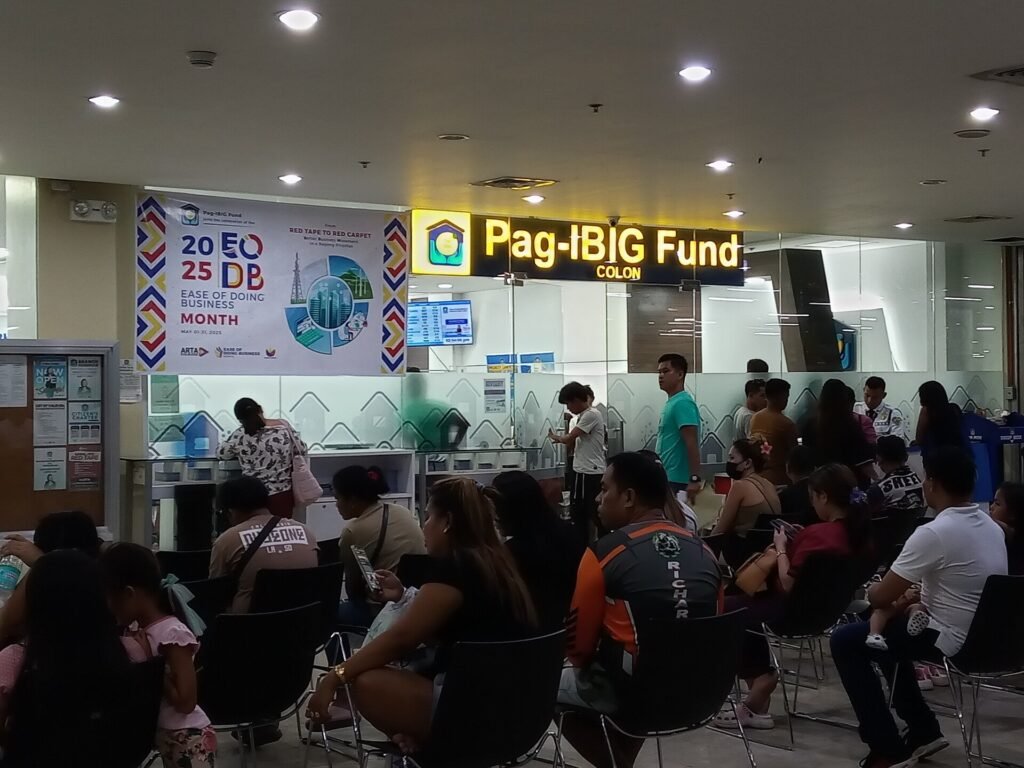
You can also register at any Pag-IBIG branch or at a Pag-IBIG desk in some government service centers. Bring a valid ID and the details you would enter online. Branch registration is useful for people without email access or who need help with the form. For general advice on bringing documents and photocopies to government offices, see our government ID and document prep checklist.
Pag-IBIG membership contribution rates
RA 9679 sets the contribution rates as a percentage of monthly compensation:
| Monthly compensation | Employee share | Employer share |
|---|---|---|
| ₱1,500 or less | 1% | 2% |
| Over ₱1,500 | 2% | 2% |
Since February 2024, Pag-IBIG has applied these percentages to a maximum fund salary of ₱10,000, under HDMF Circular No. 460. As a result, most employees now contribute ₱200 a month and their employer adds ₱200, for a total of ₱400. Members may also choose to save more than the minimum, which raises their total accumulated value and, in turn, their loan entitlement.
Paying as a self-employed member or OFW
Self-employed members and OFWs pay both shares themselves, since there is no employer. You can pay at Pag-IBIG branches, through accredited partner banks and payment centers, and through online channels listed on the Pag-IBIG website. Always use your MID number as the reference, and keep each receipt or confirmation.
For OFWs, membership is often required by recruitment agencies, and it is one of the requirements tied to overseas deployment. OFWs can also register and pay through Pag-IBIG’s overseas offices and partner remittance channels. Our OWWA membership guide covers the separate OWWA requirement.
What Pag-IBIG membership unlocks
Contributions earn yearly dividends; for 2025, Pag-IBIG declared a 6.62 percent dividend rate on regular savings. Membership also opens the Fund’s loan programs, each with its own savings requirement:
- the Multi-Purpose Loan, a short-term cash loan against your savings; see our Pag-IBIG Multi-Purpose Loan guide;
- the Calamity Loan, available after a declared state of calamity;
- the housing loan, which requires at least 24 monthly contributions; see our Pag-IBIG housing loan guide.
Pag-IBIG returns your savings with dividends at membership maturity, retirement, or other grounds explained in our guide to Pag-IBIG savings withdrawal.
Naming beneficiaries
When you register, the form may ask you to list heirs or beneficiaries. Pag-IBIG releases a deceased member’s savings, dividends, and death benefit to legal heirs, so keeping this information current helps your family later. Update it after marriage or the birth of a child, at the same time you update your civil status.
Checking your Pag-IBIG membership record
Create a Virtual Pag-IBIG account once you have your MID or RTN. Through it, you can view posted contributions, update contact details, check loan eligibility, and file some applications online. Check it every few months, and especially after changing jobs, since that is when gaps most often appear. If an employer deducted contributions from your salary but they are not posting, raise it with HR first, then with Pag-IBIG.
Pag-IBIG membership for freelancers and gig workers
Freelancers, online sellers, delivery riders, and other gig workers have no employer remitting for them, so they register as self-employed members. They declare their own monthly income, which determines the contribution, and pay both shares. Because loan eligibility depends on the number of monthly savings posted, consistent payments matter more than large occasional ones. For example, a rider who pays every month for two years will meet the 24-contribution housing loan requirement. Paying monthly also keeps the record active, which the loan forms require. If you prefer to pay several months at once, ask Pag-IBIG how it will post advance payments before you do it, so the months line up with what you expect.
Self-employed members may also need a TIN for other government transactions; our TIN ID guide explains how to get one.
Pag-IBIG membership for kasambahays
The law covers domestic workers too. Under the Batas Kasambahay, household employers must register their kasambahay with Pag-IBIG, as well as with SSS and PhilHealth. For a kasambahay earning less than ₱5,000 a month, the employer pays the full contribution. The Batas Kasambahay (RA 10361) sets out the employer’s other duties.
Getting a Pag-IBIG Loyalty Card Plus
The Loyalty Card Plus is an optional card for members. It works as a cash card where Pag-IBIG can credit loan proceeds and claims, and it gives discounts at partner merchants. You do not need it for registration, and it is not a government ID in itself, but it can make loan releases faster. Ask about it at a branch once you have your MID. Meanwhile, save your MID number in your phone and in a notebook, because every loan, payment and withdrawal form asks for it.
Merging duplicate records
People who registered more than once, for example once in college and again at a first job, may end up with two numbers. Contributions split across two records can make you look short of the required savings for a loan. Pag-IBIG can consolidate them into one MID, usually through a member’s change of information or consolidation request at a branch or online. Bring a valid ID and any old MID or RTN numbers you know of.
Updating your name and civil status
After marriage, update your Pag-IBIG membership record so it matches your new IDs. Pag-IBIG generally asks for a PSA marriage certificate and a valid ID. Do the same for corrections in birth date or spelling, using your PSA birth certificate. These changes are easier to make long before you apply for a loan or claim your savings. Our PSA marriage certificate guide explains how to get the document.
Common Pag-IBIG membership registration mistakes
- Leaving out the middle name, or entering a nickname instead of the registered first name.
- Registering again at each new job instead of reusing the same MID.
- Using an old email you no longer access, which blocks Virtual Pag-IBIG recovery.
- Paying with someone else’s MID by mistake, which posts your money to their account.
- Stopping payments after leaving a job, which makes your membership inactive.
Keeping membership active between jobs
An inactive record does not lose your savings, but it can block new loans, because the loan forms define an active member as someone with at least one monthly saving within the last six months. If you are between jobs or starting a business, you can keep paying as a self-employed or voluntary member. Even the minimum contribution keeps your Pag-IBIG membership active and your savings growing with dividends.
Last checked against RA 9679 on Lawphil, the Pag-IBIG Fund website, and the Fund’s 2025 dividend announcement reported by the Philippine Information Agency on October 2026. Registration screens change from time to time, so follow the prompts on the official site.